Educational
The Donkey in the Tiger’s Skin: A Panchatantra Tale
When a clever washerman dresses his donkey in a tiger’s skin, the village is thrown into chaos. Discover how the donkey’s own voice reveals the truth ...
1 PLAYS
5.0(1)
by Storiyaa Editorial
▶Story Transcript
Long ago, in a small Indian village bordered by dense jungle and golden fields, lived a humble washerman named Ramu. Each morning, he would collect bundles of clothes and, with the help of his loyal donkey, Dhobi, carry them to the river for washing. Dhobi was strong and hardworking, but he was also rather ordinary—gray, shaggy, and overlooked by most.
Ramu cared for Dhobi, but he often grumbled about how little grass the donkey could find to eat. The village fields were closely guarded, and the farmers chased Dhobi away whenever he tried to graze on their crops. One day, while returning from the river, Ramu’s eyes caught sight of something unusual lying near the edge of the jungle—a tiger’s skin, left behind by hunters. An idea sparked in his mind.
That evening, after finishing his work, Ramu called Dhobi over. “Listen, Dhobi,” he whispered, “I have a plan. Tonight, you will eat your fill, and no one will dare bother you.” He carefully draped the tiger’s skin over Dhobi’s back, tying it snugly around his legs and neck. Under the dim moonlight, Dhobi looked just like a tiger.
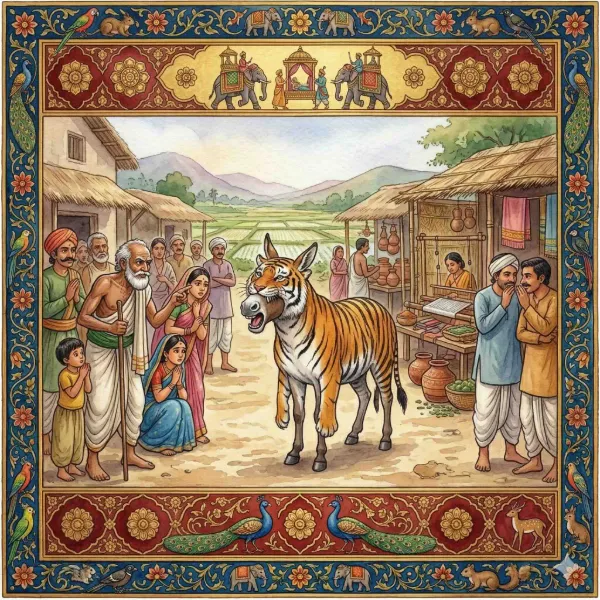
Ramu led his disguised donkey to the edge of the farmers’ fields. “Go on, eat as much as you like,” he encouraged. The villagers, peering out from their huts, caught a glimpse of the stripy figure and immediately bolted their doors. “A tiger! A tiger! Protect the crops!” they cried, but none dared to chase the fearsome animal away.
Dhobi munched on juicy crops all night, blissfully unaware of the commotion he was causing. This routine continued for several nights. Each time Dhobi entered the fields in his tiger disguise, the villagers watched in fear from a safe distance, unable to muster the courage to chase away what they believed was a wild tiger.
Soon, word spread to neighboring villages, and stories of the mysterious tiger grew wilder with every telling. Some said it was a spirit; others claimed it was the king of all tigers, come to claim the fields for himself.
But as fate would have it, pride began to grow in Dhobi’s heart. He strutted into the fields with a new confidence, savoring the fresh crops and the awe he inspired. The villagers, meanwhile, became desperate. Their crops were disappearing, and their courage was wearing thin.
One morning, Ramu warned Dhobi, “Remember, you must be silent. If anyone hears your voice, our secret will be lost.” Dhobi nodded, but he didn’t really understand. After days of feasting, he felt happier than ever, and happiness brought with it the urge to sing.
On the seventh night, as Dhobi ambled through the moonlit fields, a cool breeze rustled his fur. Overwhelmed with joy, he lifted his head and let out a loud, braying “Hee-haw! Hee-haw!”
The sound shattered the silence of the night. The villagers, who had been watching from afar, froze in shock. “Wait, that’s no tiger!” someone cried. “Tigers don’t bray like donkeys!” A group of brave farmers, armed with sticks, dashed into the field. In their anger, they yanked off the tiger skin and saw poor Dhobi trembling underneath.
Realizing they had been fooled, the farmers chased Dhobi out of the field. Ramu, who had been hiding nearby, rushed to his donkey’s side. “Oh, Dhobi,” he sighed, “your voice has given us away.” He removed the tiger’s skin for good and promised never to trick the villagers again.
From that day on, Dhobi returned to his usual chores, and though his meals were smaller, he was content. The villagers forgave Ramu and Dhobi, understanding that hunger can make even honest folk resort to clever tricks.
But as for Dhobi, he never forgot the lesson: no matter how you dress or what disguise you wear, your true nature will always come through.
And so, dear listener, the moral of the story is this: Clothes may disguise, but words reveal the truth. Always be true to yourself, for your nature cannot be hidden for long.
Related Stories

178
5.0(1)
श्री स्वामी समर्थ प्रकटीकरण कथा

100
5.0(6)
A Friend's Friend

82
5.0(1)
शाळेची घंटा | Shalechi Ghanta



18
5.0(5)