Folklore
Pabuji and the Vow of the Black Mare
Journey to medieval Rajasthan and hear the legendary tale of Pabuji, the valiant protector of cattle, whose vow and his magical black mare, Kesar Kala...
1 PLAYS
5.0(1)
by Storiyaa Editorial
About This Story
Story Transcript
In the golden sands of Rajasthan, where the sun scorched the earth and legend wove itself into every gust of wind, there lived a hero named Pabuji. Born into the Rathore clan in the fourteenth century, Pabuji was no ordinary warrior. From the moment he opened his eyes, elders whispered that he was an incarnation of Lakshman, the steadfast brother of Lord Rama.
Pabuji grew up in the village of Kolu, surrounded by tales of valor and sacrifice. Yet, it was a promise—a sacred vow—that would carve his name into the hearts of his people forever.
One evening, as the villagers gathered around a blazing fire, a desperate herdsman stumbled into their midst. His clothes were torn, his face streaked with dust and tears. He fell at Pabuji’s feet, crying, “O noble one! Raiders have invaded our pastures and stolen our sacred cows. Our land is shamed, our families left to sorrow.”
Pabuji’s eyes burned with fury. Cowherds and cattle were the lifeblood of Rajasthan. To lose them was to lose honor. He placed a hand upon the herdsman’s shoulder and swore, “As long as I draw breath, no harm shall come to the cattle of this land. I, Pabuji, vow to protect them—even if it costs me my life.”
The villagers cheered, hope rekindled in their eyes. But Pabuji knew that a vow was more than words; it was a chain stronger than iron.
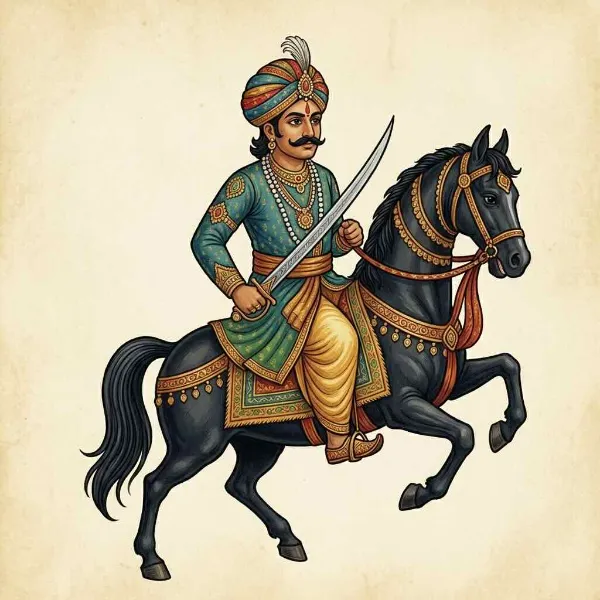
Soon after, a celestial horse appeared to him in a dream—a majestic black mare named Kesar Kalami, with a mane that shimmered like moonlit silk and hooves that struck sparks from stone. When Pabuji awoke, the mare stood outside his door, awaiting her new master.
With Kesar Kalami by his side, Pabuji gathered a band of loyal warriors. They rode across the desert, tracking the raiders to their hidden encampment along a dry riverbed. The moon hung low as Pabuji and his men crept upon the slumbering thieves.
Pabuji whispered to Kesar Kalami, “Let us show them the fury of Rajasthan.” At his command, the mare surged forward with unnatural speed, her black coat gleaming in the night. The raiders awoke to a whirlwind of hooves and steel.
“Who dares challenge us?” bellowed the chieftain, a burly man with cruel eyes.
With the wind at his back, Pabuji replied, “Return what you have stolen, and I may spare you!”
The chieftain only laughed, raising his sword. But Pabuji and his mare were unstoppable. With every leap, Kesar Kalami danced through the enemy ranks. Pabuji’s sword flashed, and with each stroke, another raider fell.
The battle raged until dawn. At last, battered and bruised, the raiders dropped their weapons and fled. Pabuji freed the stolen cattle, their bells jingling like triumphant music.
The villagers welcomed their protector with garlands and songs. Yet, the vow weighed heavy on Pabuji’s shoulders. He knew new dangers would arise. Years passed; stories spread of Pabuji and his black mare racing across the desert to save cattle from fire and famine, storm and sword.
One fateful day, as Pabuji prepared for his own wedding, a messenger arrived, breathless and pale. “The enemy rides, my lord—they threaten to slaughter the sacred cows unless you surrender!”
Family and friends pleaded, “Pabuji, wait until the wedding is done. This is your day.”
But Pabuji shook his head. “A vow is not a garment to be worn and cast aside. The cattle need me now.” He mounted Kesar Kalami, wedding garlands still around his neck, and raced to the rescue.
On the battlefield, outnumbered and surrounded, Pabuji fought with the strength of a hundred men. But just as victory seemed within reach, a treacherous arrow struck him from behind.
Pabuji fell, but even as his vision blurred, he called his men to uphold his vow. With a final effort, he freed the cattle and sent Kesar Kalami galloping to safety, her hooves echoing across the sands.
When the sun set that day, Rajasthan mourned the loss of its bravest son. But the legend of Pabuji lived on—sung by bards, painted on great scrolls, and whispered by every shepherd who watched over his herd.
For in every promise kept, every vow honored, and every injustice fought, the spirit of Pabuji rides again—undaunted, eternal, and as swift as the black mare, Kesar Kalami.
Reviews
5.0
1 reviews
Rate this story
Loading reviews...