Jataka tales are ancient Buddhist stories about the previous lives of the Buddha, in which the Bodhisatta, the Buddha-to-be, appears as an animal, a king or an ordinary person and teaches a moral such as compassion, honesty or self-sacrifice. The Pali Jataka collection contains 547 of these stories, and many were carved on the stone gateways of Bharhut and Sanchi and painted on the walls of the Ajanta caves more than 1,500 years ago. Short, vivid and often about animals, they are among the oldest children's stories in the world.
Here are nine Jataka tales with morals, each with a short summary and its traditional name, all available to listen to in English on Storiyaa.
Jataka means "birth story". Buddhist tradition holds that before he became the Buddha, Siddhartha lived countless lives, and in each one he perfected a virtue such as generosity, patience or truthfulness. In those lives he is called the Bodhisatta (Sanskrit Bodhisattva), "a being on the way to enlightenment".
A traditional Jataka has three parts: a present-day situation among the Buddha's followers, the past-life story the Buddha tells about it, and a closing line revealing who each character was. When the tales are told to children, the middle story is usually told on its own, since it is complete and easy to follow.
A monkey torments a gentle buffalo every day, riding on his back and pulling his horns. The buffalo is strong enough to crush him but chooses patience. The monkey's mischief eventually lands him in trouble all by itself.
Moral: Patience is strength, not weakness. Listen free
Caught by a falcon, a little quail says the falcon only won because it caught her in the open, away from her home ground. The proud falcon lets her go and dives again, but on her own familiar ground the quail escapes and the falcon crashes.
Moral: Know your strengths and stay on the ground you understand. Listen free
A partridge, a monkey and an elephant living by a great banyan tree agree that whoever is eldest should be honoured by the others. By remembering how the tree looked when each first saw it, they discover that the small partridge is the eldest of all.
Moral: Respect comes from age and wisdom, not size. Listen free
A lion chokes on a bone, and a woodpecker bravely climbs into his jaws to pull it out. Later, when the hungry woodpecker asks for a small share of the lion's meal, the lion says being allowed to leave his mouth alive was reward enough.
Moral: Don't expect gratitude from the ungrateful, but don't stop doing good. Listen free
A poor widow owns an old, blackened bowl that is secretly made of gold. A greedy merchant tries to cheat her out of it. An honest merchant tells her its true worth, and trust turns out to be worth more than any bargain.
Moral: Honesty is the truest wealth. Listen free
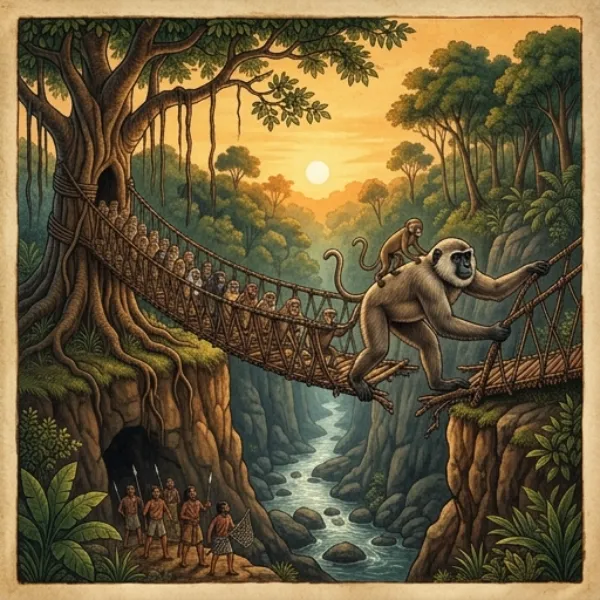
When a king's archers trap his troop in a mango tree, the monkey king stretches his own body across the river as a living bridge so every monkey can escape, even though it costs him dearly. The king is so moved that he learns what true leadership means.
Moral: A real leader puts the safety of others first. Listen
To end a king's endless hunting, the deer agree that one of them will be offered each day. When the lot falls on a pregnant doe, the golden Banyan Deer King offers to die in her place. His compassion so shames the king that he stops hunting altogether.
Moral: Compassion can change even a hardened heart. Listen
Driven by jealousy carried over from a past life, a queen sends a hunter to bring back the tusks of a magnificent six-tusked elephant. Wounded, the elephant forgives the hunter and gives the tusks himself. The queen is overcome with remorse.
Moral: Jealousy destroys the one who holds it; forgiveness frees everyone. Listen
Prince Vessantara gives freely to anyone who asks, until his generosity costs him his place in the kingdom and is tested to its limits. It is traditionally the last of the Bodhisatta's past lives before he is born as Siddhartha, and the most celebrated Jataka in Buddhist countries.
Moral: Generosity without limits is the highest virtue. Listen
They are often confused because both are ancient Indian stories full of talking animals, but they are different traditions:
A few stories, such as the talkative tortoise, appear in both, which shows how freely stories travelled in ancient India. Because the two are so often mixed up, you will sometimes see Jataka tales labelled as Panchatantra, including in some older story titles.
Browse every Jataka tale in six languages in the Jataka tales collection, or try the Panchatantra stories next.
The Pali Jataka collection of the Theravada Buddhist canon contains 547 stories, each describing a previous life of the Buddha.
The Bodhisatta (Sanskrit: Bodhisattva) is the Buddha in his earlier lives, before enlightenment. In the Jataka tales he appears as animals, kings, merchants and sages, perfecting virtues like generosity and patience.
The Vessantara Jataka is the most celebrated in Buddhist countries. For children, the Monkey King's Bridge (Mahakapi Jataka) and the Hare's sacrifice (Sasa Jataka) are among the best known.
No. Jataka tales are Buddhist stories about the Buddha's past lives that teach compassion and virtue. The Panchatantra is a Sanskrit book of fables by Vishnu Sharma that teaches practical wisdom and caution.
Storiyaa has Jataka tales in English, and several are free, including The Patient Buffalo and the Mischievous Monkey, The Clever Quail and the Proud Falcon, and The Honest Merchant and the Golden Bowl.