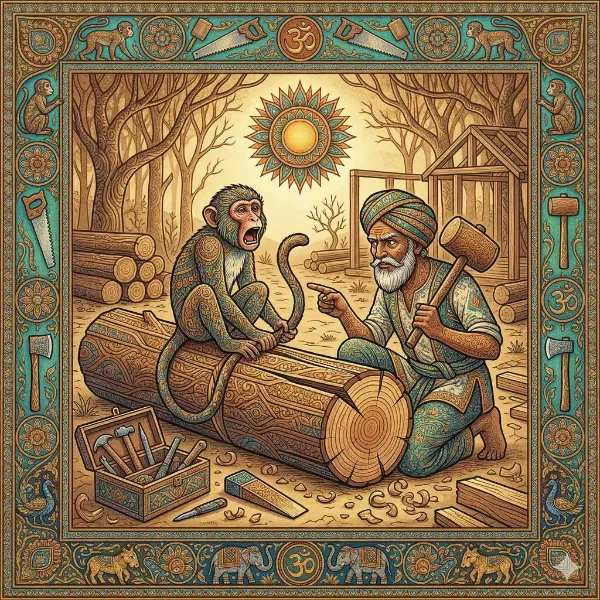
Folklore
The Monkey and the Carpenter’s Lesson: A Panchatantra Tale
When a curious monkey decides to copy a carpenter at work, he learns a painful lesson about mindless imitation. Discover the wisdom behind this classi...
2 PLAYS
by Storiyaa Editorial

Episode 9 of 16
Panchatantra Tales (en)

Up next · Episode 10 of 16
The Lion, the Camel, and the Clever Jackal
- 1
 16 plays7:01
The Fall of the Lion King
Ep 17:0116 plays
- 2
 5 plays5:25
The Lion and the Clever Little Mouse: An Aesop Fable
Ep 25:255 plays
- 3
 1 play5:52
The Fox and the Sour Grapes: An Aesop Fable
Ep 35:521 play3 ✦
- 4
 3 plays4:45
The Bear and the True Friend: An Aesop Fable
Ep 44:453 plays3 ✦
- 5
 1 play4:37
The Clever Crow and the Thirsty Problem
Ep 54:371 play3 ✦
- 6
 6:04
6:04The Clever Jackal and the Ungrateful Tiger
Ep 66:043 ✦
- 7
 5:27
5:27Friendship and Deceit: The Crow, The Deer, and The Jackal
Ep 75:273 ✦
- 8
 1 play4:57
The Brahmin, the Goat, and the Three Clever Thieves
Ep 84:571 play3 ✦
- 92 plays4:39
The Monkey and the Carpenter’s Lesson: A Panchatantra Tale
Ep 94:392 plays3 ✦
- 102 plays5:32
The Lion, the Camel, and the Clever Jackal
Ep 105:322 plays3 ✦
- 11
 1 play4:27
The Donkey in the Tiger’s Skin: A Panchatantra Tale
Ep 114:271 play3 ✦
- 12
 5 plays5:46
The Prince Who Gave Away Everything: A Jataka Tale
Ep 125:465 plays3 ✦
- 13
 5:15
5:15The Monkey King’s Bridge: A Jataka Tale of Sacrifice
Ep 135:153 ✦
- 14
 5:38
5:38The Elephant and the Queen’s Jealous Heart
Ep 145:383 ✦
- 15
 5:29
5:29The Golden Deer King’s Selfless Sacrifice
Ep 155:293 ✦
- 16
 5:24
5:24The Physician Who Healed the King’s Heart with Laughter
Ep 165:243 ✦
About This Story
Story Transcript
On the edge of a sprawling forest, where the river curved in silver ribbons and giant mango trees cast cool shade, there lived a troop of monkeys. Among them was a young monkey named Kapi, known far and wide for his restless curiosity and love for mischief.
One bright morning, Kapi watched as a pair of carpenters arrived at the riverside to build a sturdy wooden bridge. With their tools gleaming in the sunlight and their arms strong from years of work, the carpenters set about their task with skill and purpose. They sawed logs, hammered pegs, and measured beams, all with a focus that fascinated Kapi.
From the high branches above, Kapi whispered to his friend Tinku, “Look at those men! They make such strange movements with their hands and tools. I wonder what it feels like to be a carpenter.”
“Kapi,” Tinku replied, munching on a ripe mango, “why not stay up here? The forest is much more fun than all that noise and dust.”
But Kapi was already planning his next adventure. He waited and watched, memorizing every movement the carpenters made. He noticed especially how they worked with a large, heavy log split down the middle. The carpenters had placed a wedge inside the gap to keep the log open while they worked.
As noon approached, the sun grew hot, and the carpenters wiped sweat from their brows. One called out to the other, “Time for lunch! Let’s rest by the river before we finish this log.”
The moment the carpenters left, Kapi scampered down from his perch, curiosity burning brighter than ever. Ignoring Tinku’s warnings, he hurried to the half-split log and examined the wedge stuck firmly in place. The wedge was bigger than his own head, but that did not deter Kapi.
He thought, “If humans can do it, why can’t I? It looks so easy!”
Kapi climbed onto the log, imitating every move he had seen. He placed his tiny feet on each side of the gap, just as the carpenters had. He tapped the wedge with a small stone, just as they had. He even puffed up his cheeks and grunted, thinking that was part of the magic.
But as he tried to pull out the wedge with all his might, disaster struck. The wedge slipped free, and with a thunderous snap, the sides of the heavy log closed together. Kapi, caught completely off guard, let out a screech of pain. His tail and most painfully, his lower body, were trapped between the heavy halves of wood.
He tugged and pulled, yelped and whimpered, but the log held him fast. “Help! Tinku! Anyone!” he cried, his pride replaced by panic.
Hearing his pleas, the other monkeys rushed to the scene. Tinku peered down, shaking his head, “Oh Kapi, didn’t I warn you to leave human things alone?”
The monkeys tried to help, but the log was too heavy, and the gap was too tight. Kapi’s cries grew louder. Soon, the carpenters returned from their lunch and found the commotion around their log.
One carpenter sighed, “Silly monkey! Curiosity can lead to trouble when you don’t understand the work.”
The carpenters gently pried the log open and freed the shivering Kapi. He limped away, holding his aching body, while the monkeys gathered around him.
Tinku laid a gentle hand on Kapi’s shoulder and said, “Next time, let’s stick to swinging from trees and eating fruit. Some things are best left to those who know what they’re doing.”
Ashamed but wiser, Kapi nodded. From that day on, he watched the carpenters with curiosity, but never again did he try to imitate their craft.
As the sun dipped low and the carpenters finished their bridge, the monkeys settled high in the trees. Kapi’s misadventure became a favorite story among the troop, retold to every young monkey who ever wondered what humans did with their strange tools.
And so, in the heart of the forest, the monkeys learned that not every work is meant to be copied without understanding. Curiosity is good, but wisdom is knowing when to watch and when to act.
The moral of the story: Never imitate others blindly, for what suits them may not suit you. Understanding and wisdom are as important as curiosity.