Educational
The Honest Merchant and the Golden Bowl
When two merchants visit a poor widow, one’s honesty and kindness win unexpected rewards. Discover the Panchatantra tale’s wise lesson about trust and...
0 PLAYS
0.0
by Storiyaa Editorial
About This Story
Story Transcript
Long ago, in a bustling town surrounded by emerald fields, lived a widow named Kamala and her young son, Arun. Their home was modest, filled with little more than laughter and stories, but hidden among their humble belongings was an old, dusty bowl—a family heirloom that sat unused on a high shelf.
One bright morning, Kamala heard the lively cries of traveling merchants echo through the market square. Arun’s eyes sparkled with excitement. “Mother,” he pleaded, “may I go see the merchants?” Kamala smiled and nodded. “Go, and remember to observe and learn.”
The market was alive with color and sound. Stalls overflowed with silks, spices, and trinkets from distant lands. Yet amid the clamor, Arun’s attention was drawn to two merchants—Vikas and Hari—each with a tray of shiny pots, pans, and bowls. Their voices rang out, offering to trade new wares for old utensils from the townsfolk.
Arun hurried home and tugged gently at his mother’s hand. “Mother, let’s trade our old bowl for something useful.” Kamala hesitated, remembering the sentimental value of the bowl, yet she worried about their daily needs. “Very well,” she agreed, “but let us seek a fair exchange.”
They approached the first merchant, Vikas, whose keen eyes quickly assessed them. Arun handed over the old bowl. Vikas tapped it, frowning, and said, “This bowl is worthless—dull and heavy. I cannot give you anything in exchange.” He pushed it back across the stall and turned away, his voice dismissive.
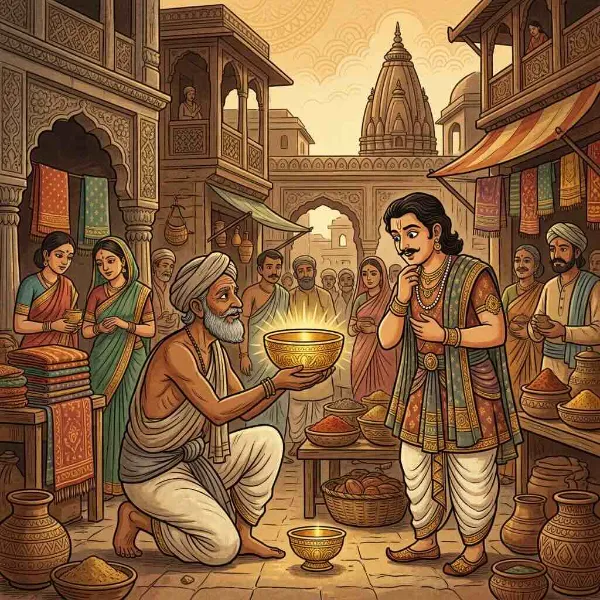
Kamala’s cheeks flushed with embarrassment, but before they left, the second merchant, Hari, stepped forward. He examined the bowl with gentle hands. As he peered closer, his eyes widened. He turned the bowl over and scraped away some of the dust with his thumb. Beneath the grime, he spotted a soft, golden gleam.
With a deep breath, Hari said, “Good lady, this is no ordinary bowl. It is made of pure gold—hidden by years of use and dust.” Kamala gasped, her heart pounding. “We had no idea,” she whispered. Hari smiled kindly. “Allow me to offer you all the pots and pans I carry, and, if you wish, the gold coins I have saved. It would not equal the true worth of this bowl, but it is all I can give for it.”
Kamala was overwhelmed by Hari’s honesty. She could hardly believe her fortune. “Your offer is generous, good sir. Please, take the bowl—it has brought me more than I ever hoped.”
At that very moment, Vikas, the first merchant, watched in disbelief as Hari began to stack his wares for Kamala. He rushed over, voice trembling with envy. “Wait! I will double whatever Hari offers! I must have that bowl!”
Hari shook his head gently, “You had your chance, friend. You called it worthless and turned this family away.” Vikas’ face darkened, but he said nothing more.
Kamala and Arun returned home with more than enough pots, pans, and gold to live comfortably. As the sun set behind the hills, Kamala sat with Arun beside their little fire. She spoke softly, “Remember this day, my son. It is not cunning or deceit, but honesty and kindness that fill our lives with real treasure.”
The story of the honest merchant spread throughout the town. People began to seek Hari’s stall, knowing he could be trusted. His business flourished, while Vikas, shunned by the townsfolk, found fewer and fewer customers.
Years later, when Arun grew up, he often retold the story to his own children. “Greed may offer quick gain,” he would say, “but trust earned by honesty is the greatest fortune one can possess.”
And so, the legacy of the golden bowl lived on—not in wealth alone, but in the hearts of those who understood its lesson.
The moral of the story is clear: True wealth lies not in what you possess, but in the honesty, trust, and kindness you share with others. In the end, those who act with integrity are always rewarded, sometimes in ways they least expect.
Reviews
0.0
Rate this story
Loading reviews...