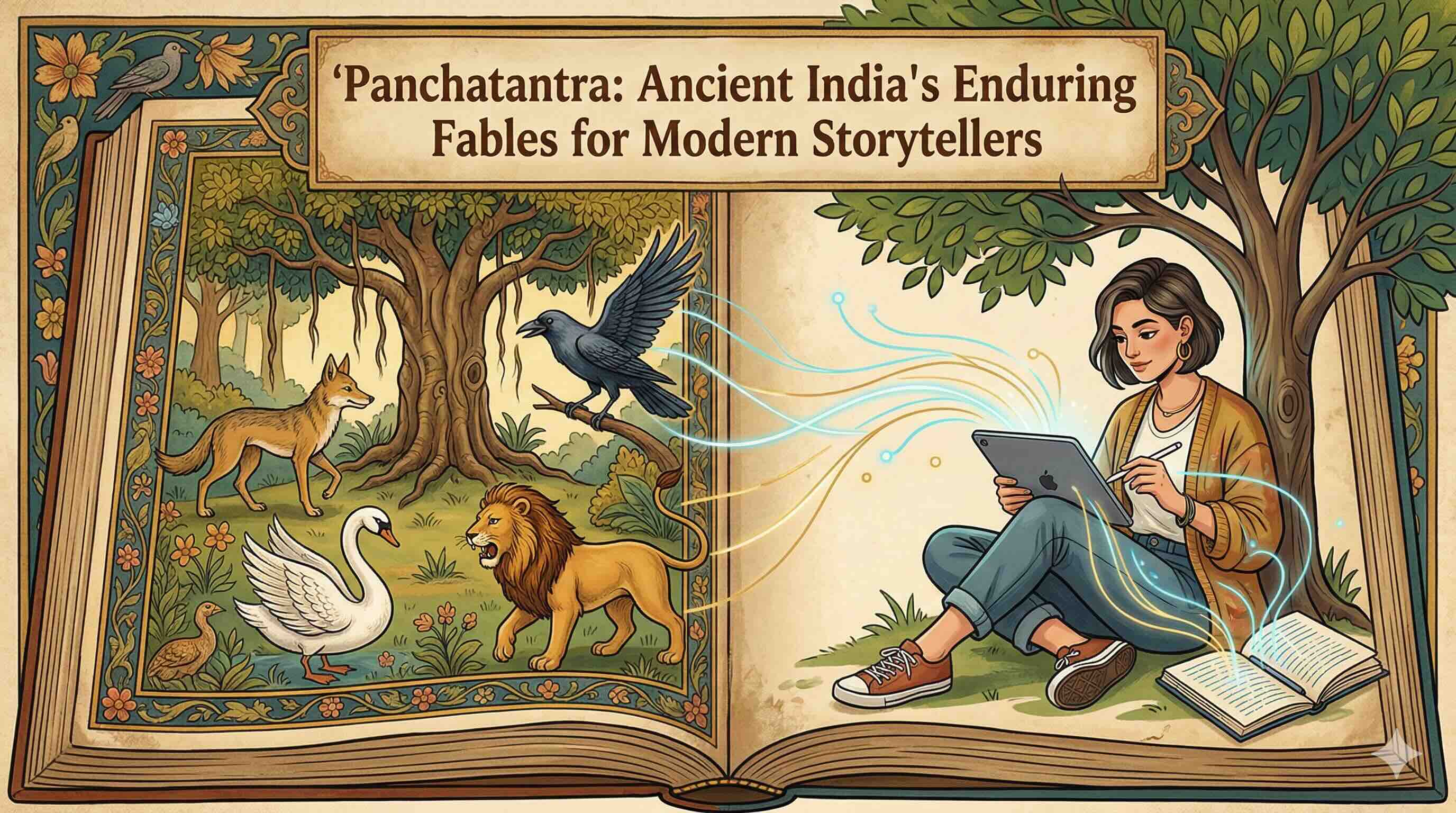
Panchatantra Stories: The Five Books and Their Best-Known Fables
Storiyaa Editorial5 min read
The Panchatantra is an ancient Indian collection of animal fables in Sanskrit, credited to the scholar Vishnu Sharma, that teaches practical wisdom through stories of clever jackals, loyal crows, foolish donkeys and quick-thinking monkeys. Its stories are divided into five books, which is what the name means ("five treatises"). Carried from India into Persian, Arabic and then European languages, it is one of the most widely translated works of Indian literature, and many fables children know today first travelled the world through it.
This guide covers where the Panchatantra came from, what each of its five books teaches, which popular "Panchatantra" stories actually come from elsewhere, and the Panchatantra stories you can listen to in English on Storiyaa.
According to the book's own frame story, King Amarashakti of Mahilaropya had three sons who refused to learn. In despair, he turned to an elderly scholar, Vishnu Sharma, who promised to make the princes wise in six months. Rather than lecture them, he told stories, fables in which animals scheme, advise, betray and rescue one another like the courtiers of a kingdom. Those stories became the Panchatantra.
Scholars date the text roughly to the early centuries CE, drawing on much older oral storytelling, though exact dates are debated. Because it was written to train future rulers, its lessons are practical rather than purely moral: how to choose friends, spot flattery, keep a cool head in danger and avoid acting without thinking.
The longest book. Two jackals, Karataka and Damanaka, work their way into a lion's court, and Damanaka poisons the lion's friendship with a bull through gossip and envy. Many famous short fables are told within it, including the monkey who pulls out a carpenter's wedge, the clever rabbit who tricks a lion with his own reflection, the blue jackal, and the talkative tortoise.
A crow, a mouse, a tortoise and a deer become friends and rescue each other from every danger, as when the mouse gnaws through a hunter's net to free the deer. A closely related story, best known from the later retelling called the Hitopadesha, tells of a jackal who befriends a deer only to trap him, until the crow comes to the rescue.
A long war between crows and owls, full of spies, strategy and the danger of trusting an enemy. One of its best-known inner stories is about three tricksters who convince a Brahmin that the goat he is carrying is a dog.
Its frame story is the monkey and the crocodile: the crocodile's wife wants the monkey's heart, and the monkey escapes by claiming he left it in his tree. The book is about losing what you have through foolishness, and keeping it through presence of mind.
Stories about acting without thinking. The most famous is the mongoose who kills a snake to protect a baby, only to be killed by the mother, who sees blood on its mouth and assumes the worst.
Also on Storiyaa: The Donkey in the Tiger's Skin, a fable about a disguise that gives itself away the moment its wearer speaks.
Some of the best-loved "Panchatantra stories" come from other traditions:
The confusion is understandable: all three traditions use talking animals and end with a lesson, and stories moved between them over centuries.
Listen to every Panchatantra story in the Panchatantra collection, and for clever human heroes try Tenali Raman stories in English.
The Panchatantra is traditionally credited to Vishnu Sharma, who, according to its frame story, told the fables to teach wisdom to the three sons of King Amarashakti.
Mitra-bheda (The Loss of Friends), Mitra-samprapti (The Winning of Friends), Kakolukiyam (Of Crows and Owls), Labdha-pranasham (The Loss of Gains) and Aparikshitakarakam (Ill-Considered Action).
Scholars generally place the Sanskrit text in the early centuries CE, built on older oral traditions, though exact dating is debated.
No. The thirsty crow, the fox and the sour grapes, and the lion and the mouse are Aesop's fables from ancient Greece, although they are very popular in India.
Storiyaa has Panchatantra stories in English, including The Monkey and the Carpenter's Lesson, The Brahmin, the Goat and the Three Clever Thieves, and Friendship and Deceit: The Crow, the Deer and the Jackal.